
Blogged by Brad Friedman on 10/29/2008 3:51PM
 [Please note several important UPDATES added to the bottom of this article. - BF]
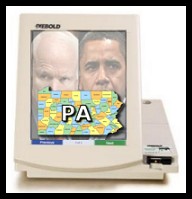
This just in from Pennsylvania... a federal court has found in favor of the NAACP and the 866-MYVOTE1 Election Reform Network, which were forced to sue the state's Democratic Secretary of the Commonwealth, Pedro A. Cortes, after his recent directive that emergency paper ballots only need to be given to the voters in the event that all of a precinct's touch-screen voting machines failed.
Most of PA uses 100% unverifiable touch-screen voting systems, and many of them broke down across the state during last April's Primary Election, leaving untold numbers of voters unable to cast votes.
As we reported when the lawsuit was filed last week, state law allows county clerks to give out paper ballots if just one machine breaks down on Election Day; Cortes' stunning decree, issued last month, went unchallenged by both the DNC and the Barack Obama campaign...
We heard the news of the court's decision a few minutes ago from John Bonifaz of VoterAction.org, the election watchdog legal organization which represented the plaintiff coalition. In a statement just issued, Bonifaz said, "This is a huge victory for the voters of Pennsylvania." He noted that "this ruling will ensure that many voters across Pennsylvania will not be disenfranchised when voting machines break down on Election Day."
The lawsuit [PDF], filed last week, called for Emergency Paper Ballots to be issued in the event that a majority (50%) or more broke down. That, despite PA election (3031..20: Section 1120-A) which allows for such ballots to be given out [emphasis added] "If any electronic voting system or any component thereof being used in any election shall become inoperable."
Cortes' directive had stated that [emphasis added again] "if all electronic voting machines in a precinct are inoperable...'emergency back-up paper ballots' shall be distributed immediately to eligible voters."
From today's ruling [PDF], as posted at Rick Hasen's Election Law Blog:
If 50% of electronic voting machines in a precinct are inoperable, "paper ballots, either printed or written and of any suitable form," for registering votes (described herein as "emergency back-up paper ballots") shall be distributed immediately to eligible voters pursuant to section 1120-A(b) of the Election Code. Emergency back-up paper ballots shall be used thereafter until the county board of elections is able to make the necessary repairs to the machine(s) or is able to place into operation a suitable substitute machine(s);
Even as it doesn't go nearly far enough, today's ruling should be very good news for Keystone Staters who saw voting machine breakdowns all across the state during their Primary Election last Spring, as we documented in some detail while they were being reported from local election watchdogs.
It should also be noted that the state GOP, at one point last week, had filed a motion to intervene in the case, to take the side of state Democrats in trying to limit the use of emergency paper ballots. We mention that just to give you an idea of how shameful the state Democrats' directive was in the first place.
Finally, credit must be given to Mary Ann Gould, a PA election integrity advocate from the Coalition for Voting Integrity and host of Philadelphia's "Voice of the Voters" radio program, for her tireless efforts in helping to bring Cortes' disturbing decree to light. Her show is listener supported, and facing difficult times, so please consider dropping something in her tipjar over there to help keep her, and her important work, on the airwaves!
UPDATE 6:10pm PT Cortes has just issued a statement to say that he will not appeal the court's decision. (See full statement at end of this article.)While his statement says he will comply with the federal court order, it also notes [emphasis added]:
As we've already noted above, PA Election Code allows for counties to give out emergency paper ballots "If any electronic voting system or any component thereof being used in any election shall become inoperable."
Does Cortes' statement mean that county clerks no longer are allowed to decide for themselves, but can only give out emergency paper ballot if 50% or more of the machines break down, instead of just one, as allowed by PA code? If so, that's quite disturbing.
No one answered the phone at the number given in the press release, but if we can learn anything, we'll update again.
UPDATE 6:30pm PT: We were able to get in touch with VoterAction.org's, John Bonifaz to ask him about the troubling language in the statement, as noted above.After we pointed it out, he too was concerned about it, while noting that the judge has ordered Cortes to issue a formal directive to change his previous directive that decreed emergency paper ballots must be given out if 100% of the voting machines break down in a precinct. That directive did not say only in the event of 100% malfunction can paper ballots be given out --- even though, Bonifaz noted, some county clerks had interpreted it that way, as testified to during eight and half hours of hearings in the case yesterday.
The statute, in PA election code, allowing for EPBs to be given out after one machine breaks down, is a discretionary one. Clerks may give out paper in that event. Cortes' original directive, Bonifaz suggests, was hopefully to have been an attempt at adding a mandatory directive to the discretionary statute (ie. "You must give out EPBs if all machines break down.")
However, Bonifaz agreed that the language used in the press release --- a direct quote from Cortes --- which says that their office will "work with county officials across the state to ensure...emergency paper ballots only be used when 50 percent of the voting machines malfunction" is disturbing.
"If this is consciously an effort on behalf of the Secretary to rewrite the discretionary statute, he would effectively be in violation of the existing statute," he told us. "It's very problematic if that language ends up in the directive," to be issued tomorrow by Cortes, he said.
"I'm concerned if the Secretary adds to a new directive the word 'only' as to when emergency paper ballots are to be distributed, because nothing in [today's] court ruling allows for that," Bonifaz says. "For the Secretary to move this in this direction, to effectively nullify the existing discretionary statute --- his abilities as Sec. of the Commonwealth do not allow him to rewrite that statute."
We will keep our eyes on the exact wording of the directive to be issued by Cortes tomorrow, and will update, of course, as we learn more.
The statement from the Cortes' office, in response to the ruling today in federal district court, follows in full below...
COMMONWEALTH OF PENNSYLVANIA
Department of State
Commonwealth News Bureau
Room 308, Main Capitol Building
Harrisburg, PA 17120
CONTACT:
Leslie Amorós
Rebecca Halton
(717) 783-1621
Department Will Work with Counties to Prepare for Election Day
HARRISBURG - Secretary of the Commonwealth Pedro A. Cortés today issued the following response to a federal court's granting of a preliminary injunction that will require polling places in Pennsylvania counties to provide emergency paper ballots if 50 percent or more of their machines malfunction. Cortés said the department will not appeal the decision.
"We have reviewed the court's opinion and we will comply with its directive per their interpretation of the state election statute. The department will work with county officials across the state to ensure the uniform application of this decision-that emergency paper ballots only be used when 50 percent of the voting machines malfunction or fail-and that an adequate supply of emergency paper ballots is available.
"That said, we hope emergency paper ballots will not need to be used extensively on Election Day. Over the past four years, counties have put systems in place to remedy machine issues, including roving technicians and additional substitute voting machines.
"We share the plaintiffs' goal of ensuring that no eligible voter leaves the polls on Election Day without voting due to excessively long lines. In order to try to reduce the potential wait at the polls, the department has worked with counties to implement procedures to improve the sign-in process. An efficient sign-in process, including the use of split poll books-that is an alphabetical listing of voters from A-M and N-Z-will help move voters through the process faster. In addition, voters who want to avoid long lines are encouraged to vote mid-day during off-peak hours.
"Conducting a successful election requires proper training and clear procedures, and with this goal in mind, the department will issue a revised directive instructing the counties on how they should use emergency paper ballots when 50 percent or more of the voting systems malfunction. The department will work closely with the counties to ensure that the emergency paper ballots are administered in a consistent manner statewide."


 With Election Day less than two weeks away, proponents of more tightly regulating the voting process --